Trial Concluded: Judge Rules Pipeline Company Trespassed But Allows Taking of Private Property

December 6, 2018, St. Martinville, LA – Today, a Louisiana judge found that the Bayou Bridge Pipeline Company (BBP) trespassed on privately owned land when it constructed its oil pipeline in the sensitive Atchafalaya Basin, but allowed the company to exercise eminent domain over the property for its use. Landowners with property interests that span 38 acres in the basin, represented by the Center for Constitutional Rights and Atchafalaya Basinkeeper, challenged the land grab and damage to the property resulting from the construction of the pipeline without their permission. Following three days of trial that concluded last Thursday, Judge Keith Comeaux awarded each of the landowners $150 in total for the expropriation and trespass. The landowners’ attorneys say they will appeal court’s ruling.

“This case was always about holding a billion-dollar corporation legally accountable for its violations of the Louisiana and U.S. Constitutions and the damage it is doing to the Atachafalaya Basin,” said Center for Constitutional Rights Senior Staff Attorney Pamela Spees. “They made a calculated business decision that it was cheaper to violate the law than to follow it. While the court did find the company trespassed on our clients’ land, the damages award validates their business decision.”

“This case was never about the money, but clearly the judge chose not to send BBP a message by adhering to their ridiculously low appraisal of the land,” said Peter Aaslestad. “The value of the land goes far beyond what you could get if you ground it up for mulch. The court missed the very real value of the property as it is and the protection it provides to the public good. Their experts only spoke about their private gain, but the basin as a whole plays a larger and much more important role for the people and the state of Louisiana. I’m glad the judge ruled in our favor on the trespass, but we are not done fighting.”

“As landowners and people with deep roots in Louisiana, we feel violated that the court didn’t take into account this wasn’t just a trespass—BBP went ahead and damaged the land and laid the pipeline knowing they didn’t have permission and not taking into consideration how that pipeline is going to affect the Atchafalaya Basin in the future,” said Theda Wright.

Attorneys say BBP trespassed onto the land and began constructing the pipeline—including clearing trees and trenching—long before beginning a legal process to obtain the land, and that the company continued construction while permits were under challenge. In addition to defending against BBP’s eminent domain lawsuit, the landowners countersued BBP for trespass and illegal construction. They argued that far from serving a public and necessary purpose that would allow BBP to exercise eminent domain, the pipeline is contrary to the public interest. Attorneys say the judge’s award to compensate the landowners $150 vastly undervalues the land.

Said Atchafalaya Basinkeeper Attorney Misha Mitchell, “Although we are disappointed the court did not find that the crisis facing Louisiana's coast and the Atchafalaya Basin warranted additional consideration in its determination of the public and necessary purpose of the project, the fact that the court found BBP unlawfully trespassed on the property at issue is substantial. For any individual to attempt to hold a huge company like BBP accountable under the law is no small feat—these landowners should be commended for their courage in confronting the illegal acts of a substantial opponent and standing for what is just.”

The Atchafalaya Basin is the country’s largest river swamp and contains old growth trees and many species listed as endangered.

“Pipelines contribute to increased flooding, coastal erosion, and climate change, and BBP’s extensive spill and leak record threatens a true environmental disaster. It is downright dangerous to allow corporations to take private land for environmentally destructive purposes,” said Bill Quigley of Loyola University Law School. “We want the courts to overturn the expropriation and take the pipeline out of the ground.”

For more information, visit the Center for Constitutional Rights’ case page.

The Center for Constitutional Rights works with communities under threat to fight for justice and liberation through litigation, advocacy, and strategic communications. Since 1966, The Center for Constitutional Rights has taken on oppressive systems of power, including structural racism, gender oppression, economic inequity, and governmental overreach. Learn more at ccrjustice.org.

Contact:

Jen Nessel, Center for Constitutional Rights, 212-614-6449, jnessel@ccrjustice.org

Anne Rolfes, Louisiana Bucket Brigade, 504-452-4909, anne@labucketbrigade.org
19th Judicial District Court Ruling, July 31, 2018

On July 31,2018, the 19th judicial district court ruled in favor of the petitioners, including ABK, LEAN, Hazel Cavalier and the Concerned Citizens of Belle River, and against the Louisiana Department of Natural Resources for its re-issuance of the permit granted to F.A.S. Environmental Services, Inc. to build a new commercial oil and gas exploration and production waste transfer station in the Basin. The court’s final judgment confirms that the agency failed to meet its own regulatory requirements and public trust duties by disregarding the environmental, social and economic impacts. Thanks to the Tulane Environmental Law Clinic’s outstanding representation in this suit! Click here to read the court's July 31, 2018 Ruling.

A Response From ABK And LCPA On Actions In The Basin, July 2018

ABK & LCPA Response – Protests in the Basin July 16, 2018

Public Statement:

Over the past two weeks, activists opposing the Bayou Bridge pipeline project have staged actions on construction sites near Bayou Pigeon, on the east side of the Atchafalaya Basin. It is our intent with this statement to have it be known that neither Atchafalaya Basinkeeper nor Louisiana Crawfish Producers Association-West were notified in advance of these actions, nor were we complicit in the execution of these actions. We neither engage in these types of actions nor do we support such without full support from the local community.

Since this project was publicly noticed for permit in 2016, Atchafalaya Basinkeeper and LCPA- West have expressed our concerns to our state and federal regulatory agencies and the public due to the perpetual trend of lack of enforcement by regulators and failure of permitted industry to comply with permits in the Basin. Basinkeeper and LCPA-West work to protect and restore the Atchafalaya Basin for future generations. We are not inherently opposed to industry. Rather, we work with all players (agencies, industry, communities and partner advocacy organizations) to restore degraded areas and ensure proposed projects do not adversely impact our wetlands through enforcement and compliance. We work with and in support of the communities in the Basin, including the crawfishing community, recreational users, families and supporters. We work with a variety of partners to educate, monitor and advocate on behalf of the health and sustainability of the Basin for all to enjoy.

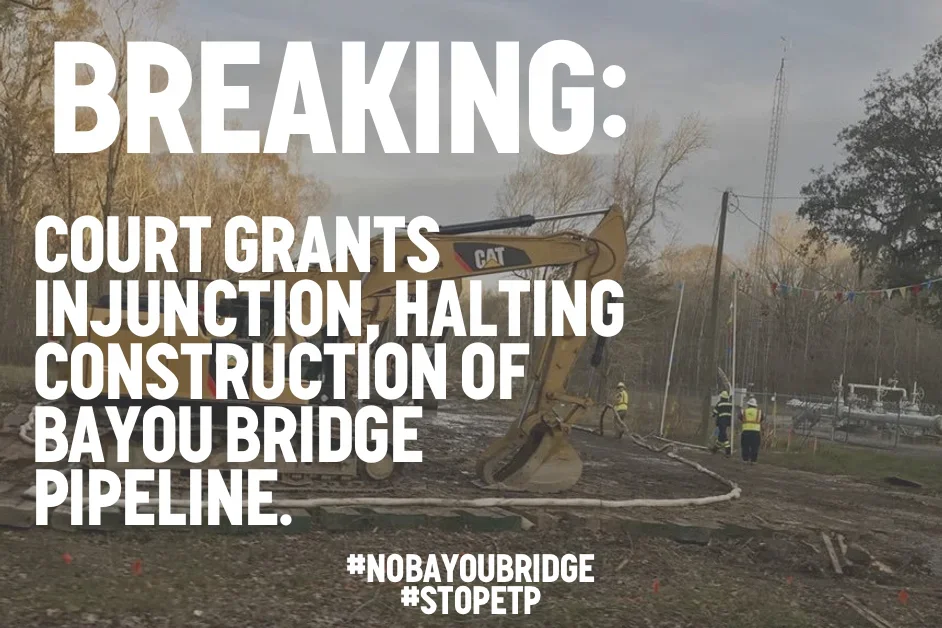
Victory! Judge Grants Preliminary Injunction To Plaintiffs In Bayou Bridge Pipeline Case

After months of tireless work from our legal team, we are excited to announce that the Preliminary Injunction filed to stop construction of the Bayou Bridge Pipeline has been granted! 

Federal District Court Judge Shelly Dick sided with the Basinkeeper on the case during the initial hearing on February 8th, stating that "irreparable harm" had been caused in the Basin.

The plaintiffs including Atchafalaya Basinkeeper, Gulf Restoration Network, Louisiana Crawfish Producer's Association-West, Sierra Club, and Waterkeeper Alliance argued on the grounds that the Corps had granted the permits prematurely, that beginning construction during a high water season would cause irreparable harm on its own, and given the severity of the ecological damage already caused to the Basin, construction must be stopped in order to determine if the Corps' decision was arbitrary and capricious. Judge Dick will assign her written statements defending her ruling at a later date. 

Protecting the Basin from Problem Pipelines

During the initial hearing, our groups presented live testimony showing that the ancient cypress and tupelo trees slated to be turned into mulch while the pipeline right-of-way is being cleared would never return, including evidence that these old-growth trees are the Noah's Ark of the swamp – providing habitat for migratory birds, bears, bats and numerous other wildlife. In addition, we showed that pipeline construction would further degrade nearby fishing grounds that local commercial crawfishers rely on for their livelihood.  

“The court’s ruling recognizes the serious threat this pipeline poses to the Atchafalaya Basin, one of our country’s ecological and cultural crown jewels,” said Jan Hasselman, attorney from Earthjustice representing plaintiffs in this matter.  “For now, at least, the Atchafalaya is safe from this company’s incompetence and greed.”  

Jody Meche, a third-generation commercial crawfisher and president of the Louisiana Crawfish Producers Association-West, testified about how the Bayou Bridge pipeline would make existing problems worse – problems created by the irresponsible behavior of oil and gas companies during construction to previous pipelines in the basin. 

These problems include hypoxic water conditions that kill crawfish, eliminating harvests in areas of the Basin, the safety of local communities and the survival of Cajun culture.   

“We fight the fight for years, telling our story, raising public awareness about the issues we have in the Atchafalaya Basin,” Meche said. “It felt great to finally be able to tell my story in a courtroom.”

“After years of witnessing the systematic destruction of the Basin with impunity by these companies, while our government turns a blind eye, it felt good to finally tell our story to a person with the power to make a difference,” Dean Wilson, executive director of Atchafalaya Basinkeeper said.  

The groups also raised concerns about the fact that construction of the pipeline would decrease natural flood protection in the basin, which acts as the major floodway project that protects millions of people in coastal Louisiana and the Mississippi River valley from Mississippi flood waters. 

The Bayou Bridge pipeline project proposes to connect the controversial Dakota Access pipeline, which transports volatile and explosive Bakken crude oil from North Dakota to refineries in St. James Parish and export terminals, forming the southern leg of the Bakken Pipeline. Energy Transfer Partners (ETP), which owns the Dakota Access Pipeline and is a joint owner in the proposed Bayou Bridge Pipeline, has one of the worst safety and compliance records in the industry.

Federal data shows that Energy Transfer Partners and its subsidiary Sunoco Inc. have been responsible for hundreds of significant pipeline incidents across the country in the last decade. Last week, Sunoco was fined a record $12.6 million by the Pennsylvania Department of Environmental Protection for violations incurred during the construction of the Mariner East 2 Pipeline.

The court ordered BBP to halt construction, citing the need to prevent further irreparable harm until the matter can be tried on the merits. The judge said the court would provide a more detailed opinion at a later date.   

The Future of the Basin

We at the Atchafalaya Basinkeeper are ecstatic about the historical changes that are happening in the Basin. The magnitude of destruction done by these companies over the last decade is hard to measure, and we may finally have an opportunity to fix these issues that have already severely effected our communities. This victory is not just a blessing, but an outcome of strenuous collaboration from our team here at ABK, our attorneys at Earthjustice and Tulane Law Clinic, and the above mentioned organizations whose support and resilience has been invaluable in driving this fight forward. 

This Sunday, we invite you to join us for our Annual Meeting, open to the pubic, at Artmosphere in Downtown Lafayette where we will discuss what this ruling means for the future of the Basin and our legal case against Bayou Bridge Pipeline.

Please join us at 1 PM on Sunday at Artmosphere Bistro in support and celebration! 

Judge Tells Why She Stopped Pipeline Through Atchafalaya Swamp

BATON ROUGE (CN) — The federal judge who granted environmentalists’ injunction to stop a pipeline from crossing the Atchafalaya Basin concluded that public interest in wetlands outweighs a company’s potential financial setbacks.

In a 60-page ruling Tuesday, U.S. District Judge Shelly Dick states why she suspended construction of the Bayou Bridge Pipeline through the Atchafalaya Basin on Feb. 23, until the case can be tried on its merits.

Dick said the pipeline threatens the health and longevity of the Atchafalaya Basin, the largest river swamp in North America. She agreed with environmentalists who filed the lawsuit that the centuries-old cypress and tupelo trees in the path of the pipeline are irreplaceable...


Court Order Pausing Bayou Bridge Pipeline Only Applies To Path Through Cypress Swamp

A federal judge’s recent order stopping construction of the Bayou Bridge pipeline — though only in Louisiana’s Atchafalaya Basin — has successfully prevented further sections of the National Heritage Area from being destroyed, for now.

On February 27, the same day U.S. District Judge Shelly Dick explained her previous week’s ruling to halt work on the pipeline, Dean Wilson, executive director of the Atchafalaya Basinkeeper, surveyed the oil pipeline's route in the basin. He was relieved to find cypress trees recently identified as “legacy trees” —  those which were alive before 1803 — still standing.

I spoke to Wilson after he toured the pipeline route. He told me he was relieved to discover much of the route through the basin’s east side still intact. The damage done on the west side was heartbreaking, but at least the pipeline has yet to be put in the ground, he said.

Drone video shot by Phin Percy, an independent camera operator, shows the pipeline route on the west side of the basin, where a swath of trees up to 75 feet deep has already been pulverized...


Judge Denies Bayou Bridge Request To Continue Construction In Basin

A federal judge has denied Bayou Bridge Pipeline's request to continue construction in the Atchafalaya Basin.

Judge Shelly K. Dick, of the U.S. Middle District of Louisiana, ordered on Friday that the company must stop work in the Basin while a lawsuit pays out over their permit to build there. The order granted an injunction sought by environmental groups who sued to stop the project, and Bayou Bridge sought a stay of that ruling.

Dick denied that motion on Monday.

Earthjustice filed the suit on behalf of Atchafalaya Basinkeeper, Louisiana Crawfish Producers Association West, Waterkeeper Alliance and Sierra Club. They seek the revocation of the U.S. Army Corps of Engineers permit for Basin construction...


Corps Was "Arbitrary And Capricious" In Granting Bayou Bridge Pipeline Permit: Federal Judge

The Army Corps of Engineers was "arbitrary and capricious" in some of its decisions granting construction permits for the controversial Bayou Bridge Pipeline, a federal judge indicating in a ruling halting the pipeline's construction until the issue can be heard in court.

In a written opinion issued late Tuesday (Feb. 27), U.S. District Judge Shelly Dick charged that the Army Corps of Engineers was "arbitrary and capricious" in concluding that a more detailed analysis was not needed before determining that the project's environmental effects could be legally offset by the company buying credits equivalent to more than 2,000 acres of damaged wetlands at mitigation banks located in different ecological areas miles from the pipeline route.

She also agreed with environmental groups that construction of the pipeline posed a threat of irreparable harm to both ancient trees within the Atchafalaya basin and to its hydrology, the flow of water through the basin...


Federal Judge: Work On Bayou Bridge Pipeline Stopped In Atchafalaya Basin, Can Continue Elsewhere

A federal court order temporarily blocking construction of the Bayou Bridge pipeline is limited to the Atchafalaya Basin, and work can continue elsewhere along the length of the 163-mile crude oil line, a judge ordered this week.

U.S. District Judge Shelly Dick clarified her Friday order stopping work with a 60-page ruling released Tuesday night, finding that environmental groups made enough of a case so far to suggest the pipeline poses permanent and irreparable risks to the basin's hydrology and environment, including to 1,000-year-old cypress in the path of the line.

"The Court finds the temporary delay in reaping economic benefits does not outweigh the permanent harm to the environment that has been established as a result of the pipeline construction," Dick wrote...

Older Posts

Drone Footage Of The Bayou Bridge Pipeline Right Of Way

Drone footage taken on February 27th shows the route where pipeline construction began and was halted on the West side of the Atchafalaya Basin. 

The Atchafalaya Basinkeeper's Dean Wilson monitored the pipeline route after the injunction was granted to suspend construction and reported back that all equipment was being removed in the Basin. 

Wilson reported that there was, "no connection to a direct sediment source found, but this could change depending how high the water comes in." 

He also acknowledged that on the east of the Atchafalaya Basin, there were legacy trees that were gone, but that most were still standing. 

"There was no trench dug on the East of the Basin at the time of monitoring, which is important to note given that the right-of-way is directly connected to two major direct sediment sources," says the Basinkeeper. 

"If it wasn’t for the judges ruling on the injunction, the consequences would have been catastrophic for the wetlands" 

ABK will continue to monitor the right of way and report on any violations that occur in contempt of the court ruling.

For now, this fragile part of the Basin is protected, but the fight is still to come in preserving the remainder of this natural treasure.